
PhD Defence: Vibe Pedersen Butler-Lund
BACKGROUND
Mortality is a central indicator of health, productivity and welfare in laying hens with economic and environmental sustainability implications for the global egg industry. Mortality is used by farmers in everyday decision-making, by veterinarians to assess hen health and diagnostic needs and by breeding companies and other stakeholders as part of breeding goals to optimise productivity. However, scientific evidence of mortality patterns and its causes is scarce. ‘Normal mortality’ has been an inherent concept to egg farming for at least 100 years, but what it means to laying hen farmers was largely unexplored prior to this project.
Public concerns about animal welfare have initiated a transition from cages to non-cage housing for laying hens in many parts of the world. In Denmark, this transitional period has radically changed the layer sector in just a decade, and barn and organic housing systems are now the most widespread.
PURPOSE OF THE PROJECT
The overall purpose of the project was to reduce mortality in laying hens in non-cage housing systems, specifically barn and organic housing. The aim was to provide a scientific foundation for understanding causes of mortality and risk periods during the production period, which may guide targeted control and preventative measures. Farmers are essential to action these measures. Therefore, it was also an aim to better understand how farmers perceive hen mortality and health, and actual causes of mortality on their farms.
RESULTS
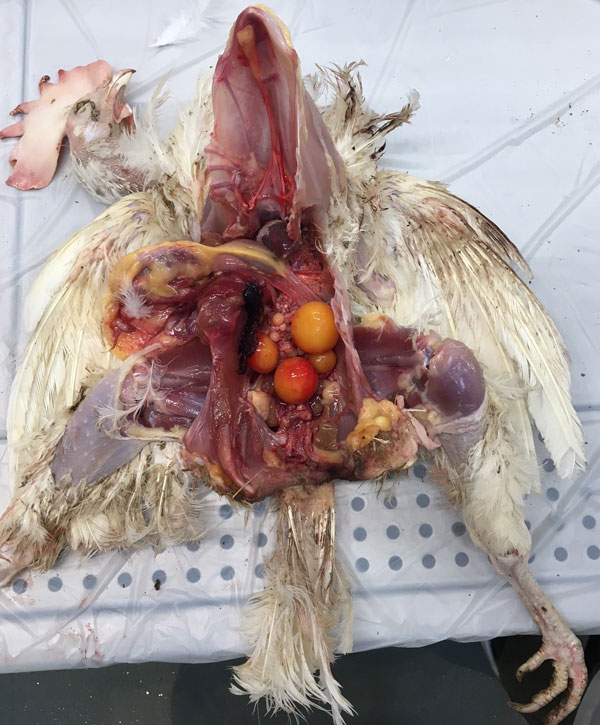
The most prevalent cause of mortality was salpingitis-peritonitis syndrome (SPS), primarily due to Escherichia coli, followed by cannibalism, egg binding, pecking, and uraemia. These accounted for the death of 71% of necropsied hens, but flock variation was substantial. Overall, non-infectious causes of mortality (64%) were more prevalent than infectious causes (38%), in contrast to farmers’ perceptions. Cannibalism appeared more prevalent in barn housing, though flock variation meant conclusions were uncertain. Cannibalism occurred either acutely or with a prolonged course with concurrent pathology. SPS and acute cannibalism appeared prevalent throughout the production period. Egg bound was associated with above normal body condition and more prevalent in younger hens, while cannibalism with a prolonged course appeared more prevalent in older hens, but a larger sample size would be needed to confirm these results.
Mean survival probability curves suggested three risk periods for increasing mean cumulative mortality: onset of lay (18-19 weeks of age), peak lay (28-29 weeks of age), and end-of-lay (> 60 weeks of age). No statistical differences were detected in mean cumulative mortality at 70 weeks of age or weekly survival probability between barn and organic housing, but further research was recommended. The period after transition from cages to barn housing appeared to pose a risk of more variable cumulative mortality patterns, which corresponded to farmers’ perceptions.
Farmers perceived ‘normal mortality’ as natural and acceptable, but highly context dependent. Farmers appeared to misinterpret and underestimate cannibalism in their hens. Perceptions of cannibalism appeared to differ between barn and organic farmers, which was interpreted as desensitization or emotional detachment and was proposed to be associated with the housing system. Farmers perceived systemic barriers to mortality control. Farmers mostly used veterinarians reactively and barn farmers had more frequent contact.
FUTURE PERSPECTIVES
Due to normalization of mortality and its causes, together with underestimation and misinterpretation of some pathologies, preventative and control measures may be delayed and/or not targeted. Scientific knowledge gaps of aetiologies and pathogeneses of prevalent pathologies may contribute to ineffective prevention. Farmers may benefit from more support to develop and implement risk-based preventative flock health management with systematic monitoring and regular follow-up. Further reductions in mortality and less variation may be achievable by addressing farmers’ perceptions.
For a copy: vl@sund.ku.dk