
KARI BÆKGAARD ERIKSSON: Dairy farming within planetary boundaries: re-thinking dairy cows into landscapes and food systems
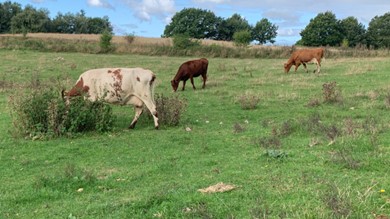
Picture from a Danish commercial dairy farm, showing two dairy cows and a heifer grazing a permanent pasture in September 2023. Foto: Kari Bækgaard Eriksson.
BACKGROUND
For more than a century, agricultural development has largely centered on increasing productivity across different farming sectors – such as increasing milk yield per cow in dairy production. While this approach has helped reduce hunger worldwide, it has also contributed to significant environmental degradation and rising rates of overconsumption. Agriculture is now a major driver of global ecological pressure, affecting climate, biodiversity, and the stability of natural systems. Research increasingly points to the need for new ways of thinking about food production that consider not only isolated efficiency measures but also planetary boundaries and long-term sustainability.
This PhD project was part of the transdisciplinary research project Cattle Crossroads, which brought together veterinarians, animal scientists and anthropologists to investigate the future of Danish cattle production through the study of pasture-based, low-input dairy farms. The project rested on the premise that reducing consumption of animal-based foods is essential for achieving a more land-efficient and environmentally balanced food system.
PURPOSE
The purpose of this PhD project was to investigate how green transition of dairy cattle production can be understood through an absolute understanding of sustainability. This understanding is based on whether planetary boundaries and local carrying capacities are respected, rather than the more common relative comparison across time and place based on productivity and efficiency estimates (for example, when some consider Danish dairy cattle production more sustainable than elsewhere based on higher milk yield per cow or lower greenhouse gas emissions per kg of milk produced compared to other countries).
Opportunities and limitations for achieving absolute sustainability were explored through fieldwork on and around dairy farms, where production was based on different goals and perceptions of sustainability than those typically encountered in intensive Danish dairy production. This included the use of permanent grasslands, a focus on soil health, low or no use of concentrate feed, and integration of cattle and plant-based food production.
RESULTS
Across three studies, the project explored how dairy cows can be integrated into semi‑natural landscapes and organic crop systems in ways that improve ecosystem health while optimising overall food output. Such integration aligns with future food system needs, where greater reliance on plant‑based diets will be essential.
A mixed‑methods study of four organic, pasture‑based dairy farms led to the development of a new, situated land‑use analysis method. By combining landscape variability with a whole food‑system perspective, the method evaluates land‑use efficiency in relation to the dual challenge of feeding a growing global population while reducing environmental pressures. Results showed that dairy systems following the “feed‑no‑food” concept and grazing land unsuitable for human‑edible crops required the least arable land per unit of human‑digestible energy. Qualitative insights helped interpret these findings and strengthened their reliability.
Long‑term fieldwork, body‑condition monitoring and biodiversity assessments further showed how nature‑inspired grazing can support functional – and sometimes genetic – biodiversity without compromising cow health. However, biodiversity benefits were only found on the most extensively managed permanent pastures, and cow condition depended on multiple interacting practices, not only feeding design. Further research is needed to quantify broader environmental effects.
Finally, by applying the Doughnut Economics framework, described by economist Kate Raworth, the thesis proposes seven ways “to think like a 21st‑century agronomist.” This includes landscape‑specific goals, using embedded efficiency metrics and paying attention to interspecies relations. Overall, the results point toward alternative dairy systems with fewer animals, stronger crop integration and greater ecological resilience.
FUTURE PERSPECTIVES
This thesis can serve as both inspiration and a foundation for further exploration of holistic approaches to food and dairy production – and the opportunities they offer for supporting the agricultural sector’s absolute green transition. These approaches highlight the value of integrating ecological functions, land‑use awareness, and system‑level thinking into everyday farming practices.
Moving forward, these developments require active engagement and interdisciplinarity among agricultural actors, organisations, and knowledge institutions. This includes making space for diverse dairy production systems that consider local carrying capacity while acknowledging globally relevant environmental impacts. Embracing broader metrics, collaborative knowledge practices, and new forms of agronomic thinking can facilitate a transition towards agricultural systems that are more resilient, regenerative, and aligned with planetary boundaries.
More info about the project: