
Dhiraj Krishna: Biosecurity Considerations in Atlantic Salmon Recirculating Aquaculture Systems (RAS)
 BACKGROUND
Atlantic salmon (Salmo salar) is a globally vital aquaculture species, with major production hubs in Norway, Chile, Canada, Scotland, and the Faroe Islands. Atlantic salmon production can be broadly classified into two stages: a land-based juvenile freshwater stage and a sea-based grow-out phase. The smolt stage increasingly relies on land-based Recirculating Aquaculture Systems (RAS) that reuse 90–99% of water. While RAS offer superior water quality control and biosecurity, high fish stocking densities and continuous water recirculation create complex microbial environments where pathogens can persist and multiply.
Disease outbreaks remain a primary threat to economic stability in regions like the Faroe Islands. Key pathogens include infectious pancreatic necrosis virus (IPNV), avirulent infectious salmon anaemia virus (ISAV-HPR0), orthoreovirus piscis (PRV-1), salmon gill pox virus (SGPV) and Flavobacterium psychrophilum. Of particular concern is the ability of pathogens such as ISAV-HPR0 and IPNV to establish themselves as "house strains" within components of the RAS. Persistent, avirulent ISAV-HPR0 variants can mutate into virulent ISAV strains, leading to significant mortality and economic losses. Consequently, maintaining rigorous, system-specific biosecurity is essential to prevent pathogen entry and mitigate the risks inherent to intensive, closed-containment Atlantic salmon production.
PURPOSE
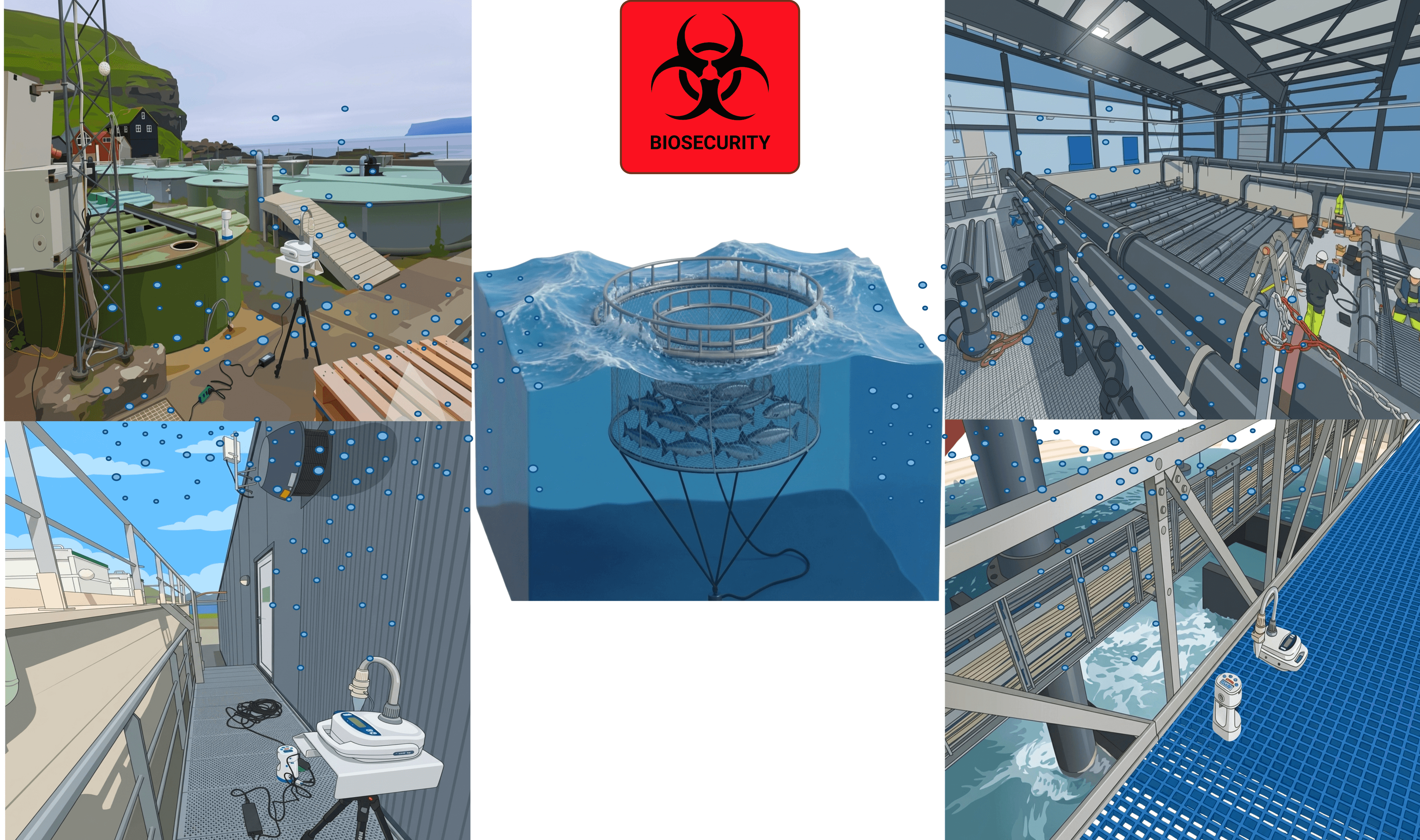
The thesis focused on infection dynamics of key Atlantic salmon pathogens in Faroese RAS and aimed to evaluate water samples with environmental DNA/RNA (eDNA/eRNA) for early infection detection, study aerosol-mediated transmission as a biosecurity risk, and map ISAV-HPR0 transmission pathways and evolution in Faroese farms. The work was carried out under the following objectives:
- To identify major pathogen entry points in Atlantic salmon RAS, with an emphasis on air and aerosols as potential transmission pathways, and to address critical biosecurity challenges in intensive RAS production
- To elucidate the infection dynamics of Atlantic salmon pathogens, salmon gill poxvirus (SGPV), avirulent infectious salmon anaemia virus (ISAV-HPR0), infectious pancreatic necrosis virus (IPNV), orthoreovirus piscis (PRV-1), and the opportunistic bacterium Flavobacterium psychrophilum
- To investigate the transmission routes and the potential for virulence evolution from avirulent strains (ISAV-HPR0) to highly pathogenic strains (ISAV-HPRΔ) through NGS on the Oxford Nanopore platform.
Shared objectives:
4. To assess the potential of biofilter carriers (biomedia) to harbour pathogens, in collaboration with ESR1 - RASOPTA (Fernando Fernando, PhD student, NTNU, Norway)
5. To recommend relevant Atlantic salmon pathogens found in freshwater RAS, along with their genetic material, for inclusion on the high-throughput Fluidigm chip to ESR12 -RASOPTA (Hanxi Li, PhD student, DTU, Denmark).
The thesis presents the results as four papers/manuscripts.
RESULTS
The thesis presents the results as four papers/manuscripts.
Paper I mapped the infection dynamics of key pathogens in Faroese smolt production and validated the use of water-sample eDNA/eRNA as a cost-effective early-warning tool for infections.
Paper II investigated aerosol-mediated pathogen transmission within RAS and provides the first evidence of aerosolised eDNA/eRNA from relevant salmon pathogens in Faroese RAS. The study also reports the first successful isolation and propagation of a viable fish pathogen, IPNV, from aerosol samples in a RAS facility.
Paper III validated the “house-strain” theory for ISAV-HPR0, showing different phylogenetic clustering of ISAV-HPR0 in individual farms, which suggests that persistent “house-strains” are well-adapted locally. Additionally, phylogenetic data suggest that ISAV-HPR0 was introduced from marine sites into naive farms, likely via contaminated aerosols, thereby breaching biosecurity measures.
Paper IV examined RAS biofilters as potential pathogen reservoirs, frequently detecting the opportunistic pathogen F. psychrophilum, along with ISAV-HPR0 and IPNV in a subset of samples. Overall, these findings highlight critical vulnerabilities in biosecurity and provide a basis for future efforts to prevent and control biosecurity risks.
FUTURE
The PhD research was carried out at a commercial Atlantic salmon RAS farm under real-world conditions, offering a practical perspective on infections in RAS. The findings highlight the crucial importance of biosecurity in preventing pathogen entry and spread within RAS. Water samples (eDNA/eRNA), while not diagnostic, could serve as a non-invasive, cost-effective method for monitoring such introductions. With an understanding of the aerosolisation of key Atlantic salmon pathogens, it is also vital to emphasise the need to disinfect both the intake and exhaust air in RAS. While a link indicating ISAV-HPR0 transmission from marine farming sites to RAS smolt farms has been established, definitive transmission mode via aerosols needs to be elucidated. Most biosecurity protocols employed in smolt farms often do not include specific measures to sanitise the air. A comprehensive approach to reduce pathogen entry and release from smolt farms is essential to maintain biosecure production conditions. Appropriate measures, such as physically separating RAS compartments with barriers at air intake and exhaust, could help limit pathogen entry and spread. Additionally, treatment of RAS effluent water may be implemented to prevent the release of pathogens into the surrounding marine environment. Overall, the thesis offers a comprehensive overview of biosecurity considerations in Atlantic salmon RAS.
Relevant links:
Airborne virus transmission risk detected in salmon RAS systems
First study showing probable airborne transmission of these fish viruses in RAS
Dhiraj Krishna
Contact info: DKR@HFS.FO /GNC677@SUND.KU.DK